
Stoughton Previous Residents Sources
The backward trail works best when each source is assigned a period and purpose. Norfolk land records identify conveyances and legal references. Directories and newspapers place people at an address or business during particular years. Census schedules describe households at released intervals. Permits can date work, while historic house material can expose a moved building or an earlier road name. The records do not all describe the same thing, so an owner, occupant, builder, or person mentioned in a notice should never be treated as interchangeable.
| Source | Years It Covers | Where Held | What It Shows |
|---|---|---|---|
| Norfolk recorded land | 1793-present online index and images | Norfolk County Registry of Deeds | Conveyances, mortgages, plans, and legal descriptions |
| Norfolk registered Land Court | System from 1901; guide indexes from 1973 | Norfolk Registry and Land Court system | Certificates, encumbrances, and registered plans |
| Stoughton directories | 1883-1942 selected State Library years; Polk's 1930-31 | State Library, local Library, and scan leads | Occupants, businesses, and sometimes a street or house guide |
| Stoughton newspapers | Archive statement begins 1863 | Stoughton Library archive and SC collection | Moves, obituaries, sale notices, construction, and family mentions |
| Federal census | 1790-1950 released, then a rolling 72-year rule | NARA and library research services | Household members, ages, relationships, occupations, and residence |
| Historic house files | Early-house and map/deed references | Stoughton History, Historical Society, and Library | Original owner/date leads, house movement, and place-name context |
Begin with the source closest to the date you know. For a current parcel, use the assessment and GIS record before opening the deed chain. For an old family address, a directory or newspaper can supply the spelling, road name, or year needed to make the land search practical.
Stoughton Address Records Start With a Parcel
For previous residents, the documented Stoughton method starts at the present parcel rather than a guessed surname. Use the Stoughton Property Assessment Data / Patriot Properties WebPro and the town's People's GIS to preserve the parcel ID, situs address, current owner, and Book/Page. WebPro is an annual ownership snapshot. The town directs current ownership questions to People’s GIS, which it says is updated daily. The pair gives a better starting record than either source alone.
The Stoughton old homesteads list provides local house-history leads with owners, dates, and current addresses.
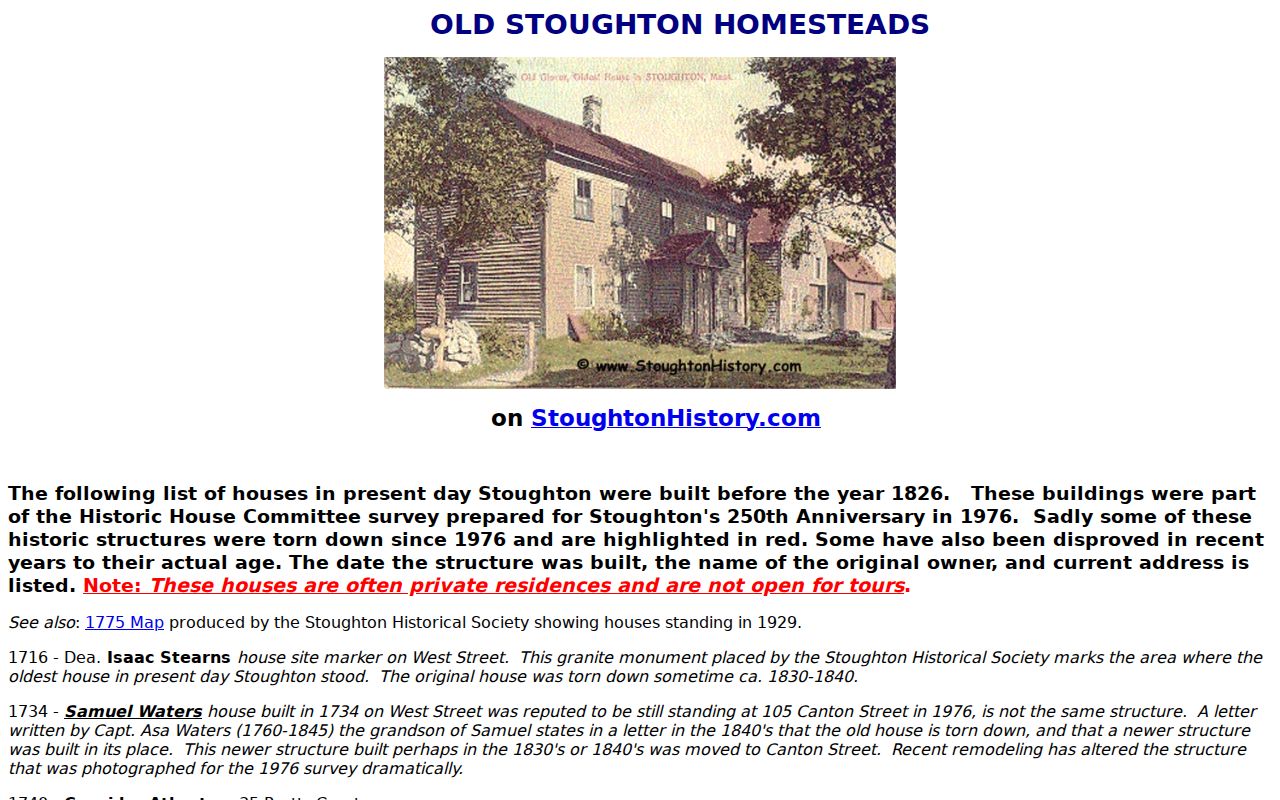
An old-house list can suggest where to look, but it is not a deed chain. Keep the parcel, Book/Page, map reference, and actual document separate so a historic address label does not become the whole conclusion.
Stoughton Previous Residents Need Two Land Systems
The Norfolk Registry has a local complication that matters when tracing past residents through ownership: recorded Registry land and registered Land Court land are separately indexed. The Registry describes roughly 80 percent as recorded land and roughly 20 percent as registered land. An address search is combined, but a name search may require both paths. If a deed search finds the present conveyance but no earlier purchase, check whether the parcel is in the other system before deciding the chain ends.
Online images reach to 1793. Address indexing is strongest from 2003 forward, while older research is better driven by name, date, legal description, plan, road, owner, and surveyor references. The Registry also has scanned index books from 1793 to 1955 and reports transcribed handwritten documents for 1793 to 1900. This is why the Book/Page from the current parcel is so valuable.
Note: An address result is a convenient lead, but an old deed's legal description and indexed parties provide the stronger backward trail.
Stoughton Address Records and the Moved House
The Samuel Waters house is a Stoughton warning against treating a modern number as permanent history. Historical Society material traces a structure built around 1731-34 on West Street that moved to present 105 Canton Street in the 1840s. The account compares a 1749 map, an 1835 Dedham deed, and 1849 and 1853 Canton Street deeds. Canton Street itself was not accepted as a town road until 1850. A former resident of the site may not be a former resident of the same structure.
The Stoughton historic-house chapters show the map and deed context behind that continuity problem.
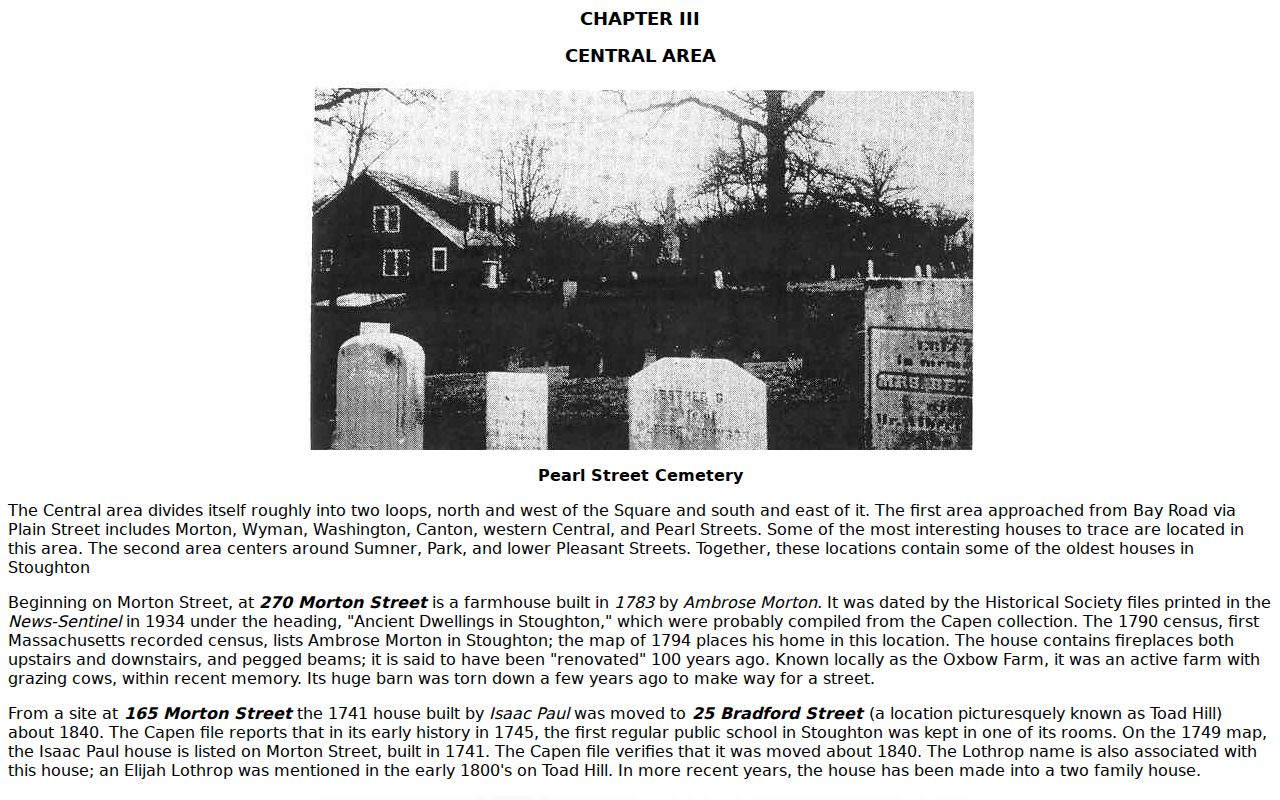
When an address changes shape across time, write down the road name, map date, structure move, and deed description separately. This prevents one record from being attached to the wrong building or parcel.
Stoughton Map Records Before Street Names
Old maps are the bridge when an earlier record uses a road that lacks a modern number. Stoughton History points researchers to 1775, 1794, and 1831 maps, while the town GIS street-name index helps translate a street-only clue into the current map. Historic Stoughton was also much larger than today's town. The original 1726 township later contributed territory to Canton, Sharon, Avon, Foxborough, Plainville, and North Bridgewater. A family can appear under Stoughton in an early record and under a successor town later.
The Stoughton historical chronology supplies the boundary and road-history context.
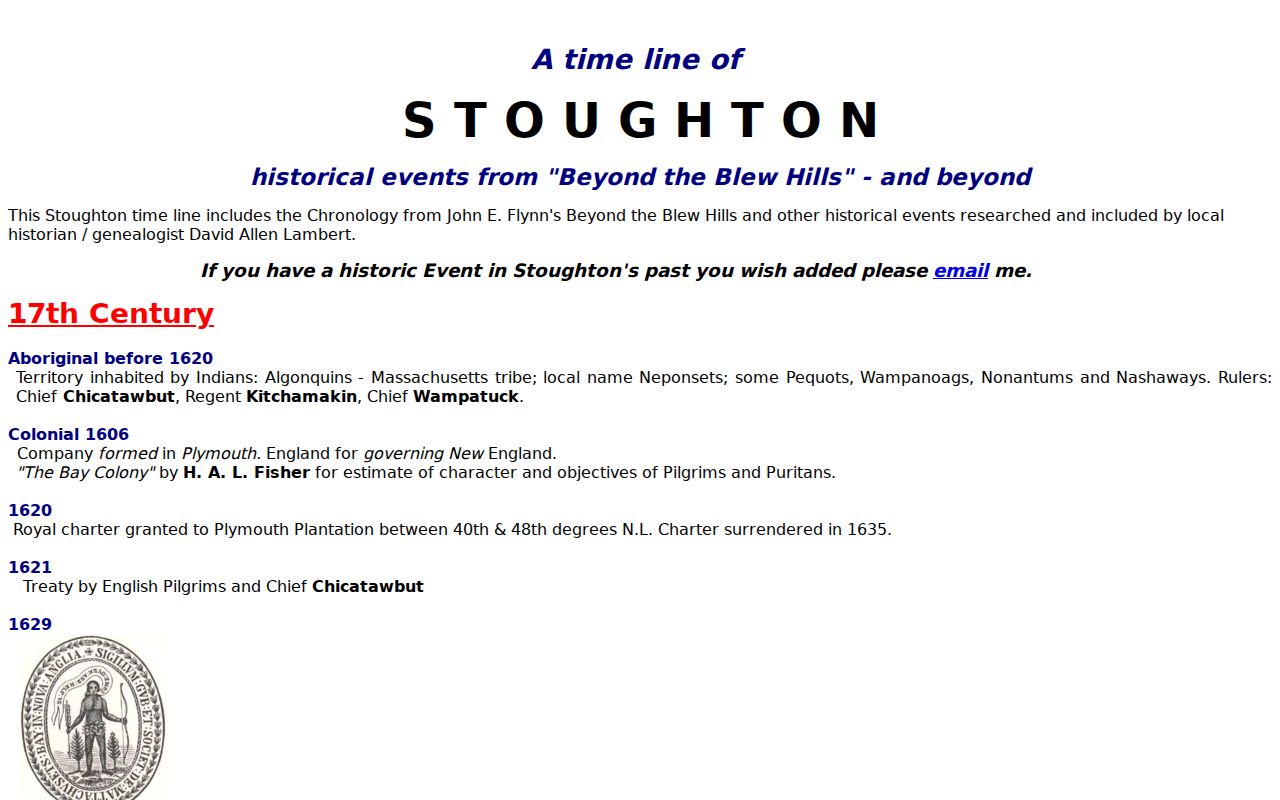
The chronology is a jurisdiction check, not an address directory. Use it to decide which town's deeds, directories, vital records, or maps deserve the next search.
Stoughton Previous Residents Deed Trail
Open the Norfolk County Registry of Deeds online research route with the parcel details beside you. The goal is a chain of ownership, not a list of occupants. A conveyance names the grantor, the person giving the interest, and the grantee, the person receiving it. Copy the recording date, Book/Page, document type, legal description, and prior-deed reference before moving backward. If a parcel is registered land, follow its Certificate of Title and encumbrance list in the Land Court system.
- Record the current parcel ID, situs address, owner, and Book/Page from WebPro or People’s GIS.
- Find the current owner's purchase deed in the Registry index and transcribe the grantor, grantee, legal description, date, and prior reference.
- Search the seller as a grantee to locate that seller's earlier purchase of the same property.
- Repeat the handoff from deed to deed, comparing legal descriptions and plans whenever the street number changes.
- Switch to Land Court when the parcel or a missing name search indicates registered land, then follow the certificate and encumbrances.
- Use the Registry's index books, plan search, genealogy desk, or public request route when an older link or image needs staff help.
- Grantor and grantee
- The grantor transfers an interest. The grantee receives it. In a sale, each name helps locate the adjoining deed in the chain.
- Chain of title
- The sequence of conveyances connecting one owner to earlier owners. It must be checked against legal descriptions, not just matching surnames.
- Legal description
- The lot, plan, subdivision, or metes-and-bounds wording that identifies land. It can survive when a street number or road name changes.
Stoughton Previous Residents in Directories and Census
Ownership is only one layer of who lived here before. After the deed chain establishes an owner and time range, look for people at the address in city directories, newspapers, and released census schedules. The State Library's selected Stoughton runs cover 1883 through 1942, including the named 1930-31 Polk volume. Directory entries can show a residence, trade, or business connection. Census records can add relatives, ages, and occupations. Neither one should be read as a complete list of every person present.
The Stoughton genealogy route explains local research limits and request information.
The local genealogy request page is a fallback when a town-held historical record needs staff research. It states a pre-1920 research fee and processing window, so confirm current details before submitting a request.
- Choose the directory volume nearest the recorded deed date and copy the full entry, including initials, address, trade, and abbreviations.
- Search the closest released census year and compare names, relationships, ages, and occupations with the address and directory evidence.
- Check the next surviving directory year and local newspaper notices for a move, marriage, death, sale, or business change.
- Resolve an address mismatch with the parcel, road history, and deed legal description rather than assuming an old number is the same place.
The actual volumes and their access channels are described in the Stoughton city directory collection. That research is most useful after the parcel and date range have narrowed the question.
Stoughton Previous Residents Endpoints
Newspaper and probate evidence can explain the last step in a Stoughton household trail. The town-linked newspaper archive begins in 1863. Search a surname, spouse, old street spelling, "estate," "sold," "moved," and a business name. An obituary can name a residence, survivors, funeral home, cemetery, or a later town. Those details are leads to verify with the death record, Probate and Family Court docket, and deed chain.
The Massachusetts genealogical research guidance outlines state archives and vital-record research paths.
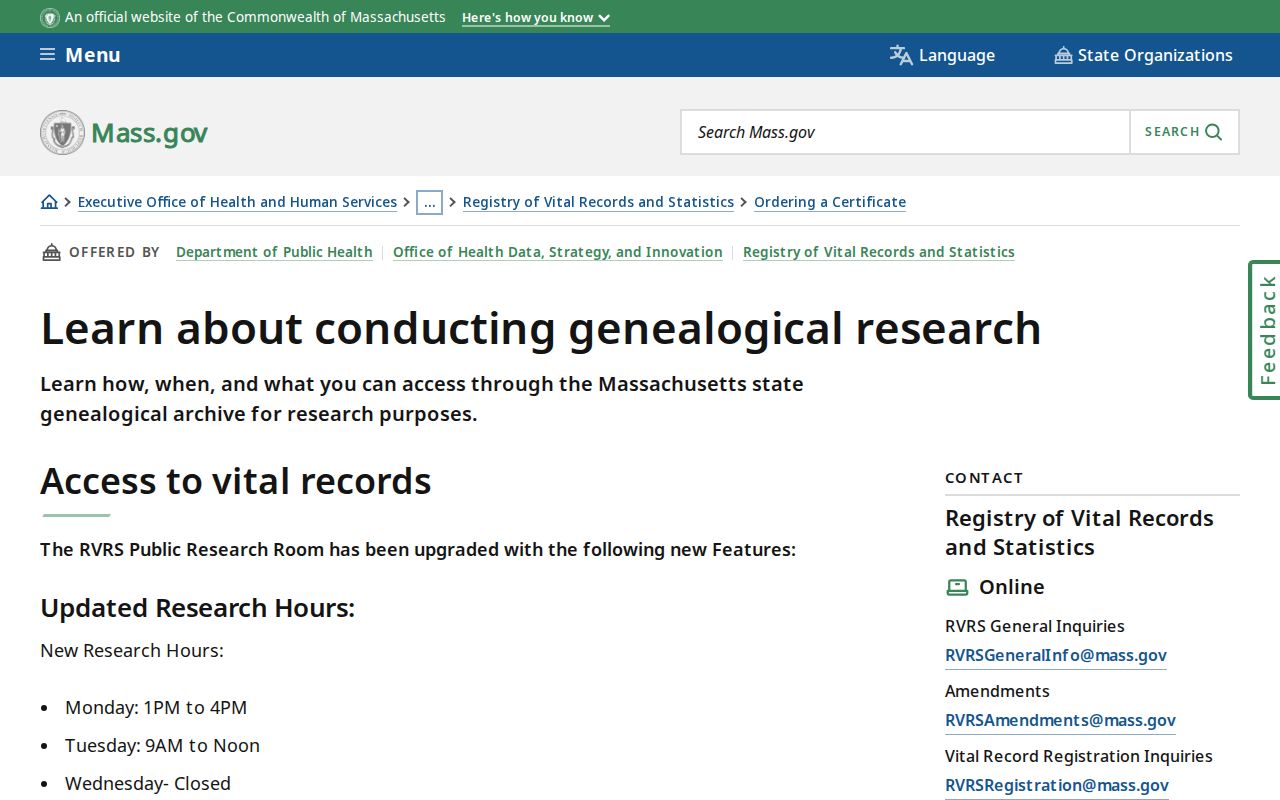
State resources complement the town and county trail when a family crossed the old Stoughton boundary or when a vital or naturalization record is held outside the local collection.
Stoughton Previous Residents Research Limits
No verified Stoughton reverse-directory publisher or exact year run was located in official online sources. No verified Stoughton Sanborn map run was located either. Treat those as catalog and reading-room questions, not as proof that no street guide or map exists. The fallback chain is the Library Historical Room, the Historical Society at 6 Park Street, the Registry genealogy desk for deeds, plans, atlases, and historical records, and a request to the record custodian for an existing public record.
Town records not published online can be requested through the Town Clerk or the relevant department under the Massachusetts Public Records Law, M.G.L. c. 66, § 10. The law permits oral or written requests and requires a custodian response within 10 business days, subject to exemptions. Request a defined record by address and date. Do not ask an office to create a new list of former occupants.
Lawful use. Stoughton previous-resident research is appropriate for family history, house history, estate questions, and personal curiosity. Respect protected addresses and never use a record to stalk, harass, threaten, or repeatedly contact a living person.
Note: A past address can be a useful historical fact, but it is not permission to seek private details about present occupants.